

CIA Project Artichoke
Not a wholesome memorandum on garden logistics.

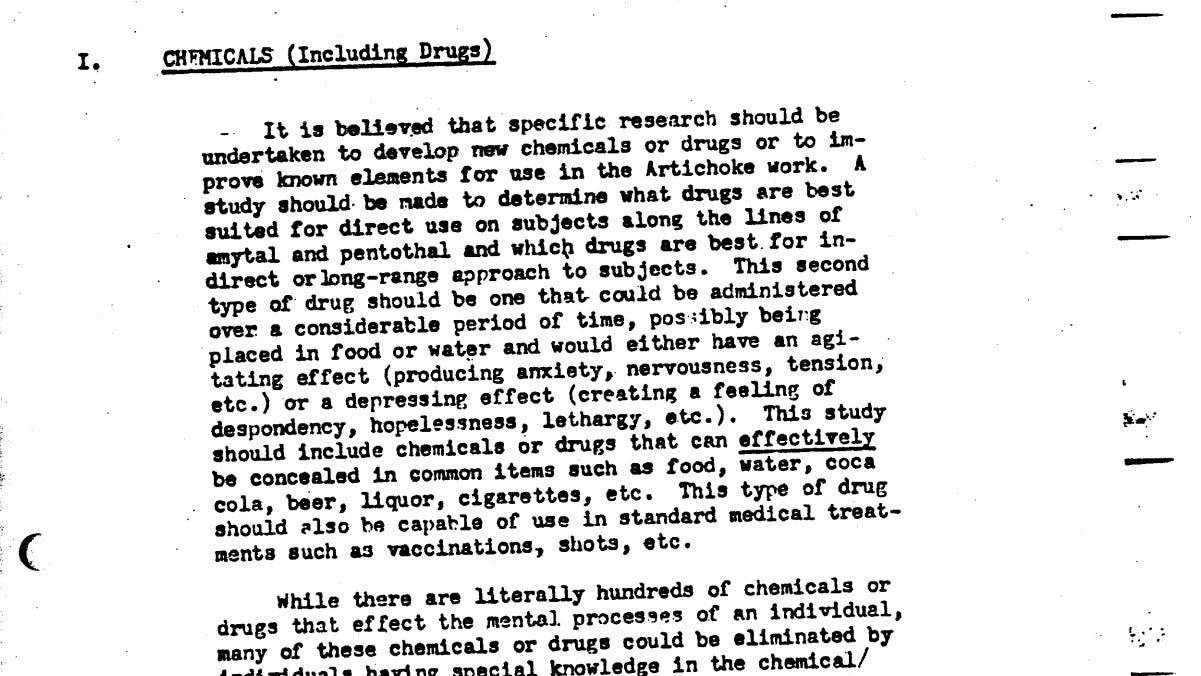

T.W. Burrows would like to issue a correction to the burrow community regarding what he initially believed was a generous federal produce initiative. For several hours this morning, after hearing the phrase “Special Research for Artichoke,” I assumed the Central Intelligence Agency had finally turned over a new leaf and was distributing free vegetables to the public in little wicker baskets, perhaps with recipe cards, a vinaigrette, and a modest apology for the twentieth century. I pictured men in grey suits unloading crates of globe artichokes in church parking lots while smiling too hard and asking whether anyone had experienced unusual suggestibility after supper. It seemed, frankly, overdue. If one has spent decades destabilising continents, one might at least sponsor a seasonal farmer’s market.
Alas, dear readers, the matter concerns not edible thistles but Project ARTICHOKE, which turns out to be exactly the sort of thing that causes a rabbit to stop chewing and stare into the middle distance for a full minute. Burrows, having tunnelled through the actual declassified CIA memo, can report that this was not a wholesome memorandum on garden logistics. It was a 1952 internal research proposal discussing possible avenues for coercive manipulation, drug delivery, and assorted nightmare methods that read like a sadistic science fair assembled by men who believed ethics was a communist plot. The document ranges widely, as if the author had stood in a laboratory, spun in a circle, and shouted, “Yes, let us investigate all of it.” Drugs. Gases. Aerosols. Pressure. Sound. Electroshock. Diet manipulation. Psychological disorientation. The memo explicitly discusses developing substances that could be concealed in everyday things and says such materials should also be capable of use in standard medical treatments, such as vaccinations and shots.
And here the Ministry of Reassurance clears its throat and informs us that this is all perfectly normal archival nuance. “You see,” says the polished spokesman, “while it is true that the agency contemplated covert drugging via food, drink, cigarettes, and vaccinations, one must remember this was merely a research suggestion list, and therefore the public should remain calm, trusting, and ideally boostered.” To which I reply that when a fox is discovered drafting a memo titled Innovative Applications for Henhouse Access, the distinction between proposal and implementation matters very much in court, but it does not make the hens irrational for becoming alert.
The defenders of permanent innocence often retreat to a childlike formula. They would never do that. These men? These institutions? Against their own people? Perish the thought. I admire this faith the way I admire a rabbit standing upright in a thunderstorm wearing a copper hat. It is brave in a decorative sense. History, however, is cluttered with officially documented episodes in which serious men in offices did exactly the kind of thing they solemnly explained they would never do.
Then we encounter the most convenient ghost in the archive. Many records tied to behaviour control programs were destroyed in 1973. Splendid. The very people who now request evidentiary perfection helped curate the evidentiary crater. We are left with fragments, proposals, scattered memoranda, testimony, partial paper trails, and that peculiar smell that arises whenever institutions burn documents for the public good.
So yes, I began the day expecting an article about vegetables and perhaps a federal aioli program. Instead, I found a declassified memo in which powerful men calmly explored methods for manipulating human beings and floated delivery mechanisms that included ordinary medical channels. If that leaves you with an uneasy feeling, congratulations on your functioning instincts.
 | A guest post by
|